Bursa / Nilufer
Bursa · Rhinoplasty Guide
Packing-Free Rhinoplasty
A modern rhinoplasty approach that prioritizes patient comfort by avoiding the placement of traditional gauze nasal packing inside the nose — meaning less post-operative pain, swelling, and bruising.
Quick Summary
Packing-free rhinoplasty is an approach where different tissue support and bleeding control techniques are preferred instead of the traditional gauze packing used in conventional methods. The goal is to increase post-operative comfort while preserving respiratory and olfactory functions. For general information about rhinoplasty planning in Bursa, you can also check our main guide page Bursa Rhinoplasty.
Definition
What is Packing-Free Rhinoplasty?
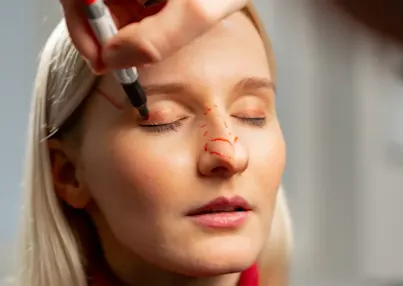
Packing-free nose surgery is a surgical procedure performed without placing a traditional gauze tampon inside the nose. The technique is applied to improve nasal aesthetics or respiratory functions. The absence of a tampon allows patients to breathe much more comfortably after surgery.
During the bone shaping stage, ultrasonic vibration technology can also be used in some cases; you can find more information about this on our Piezo (Ultrasonic) Rhinoplasty page.
Comparison
Difference from the Traditional Packed Method
Traditional Method
- A gauze tampon is placed inside the nose
- The patient may feel discomfort/pain when the tampon is removed
- Breathing through the nose can be difficult during the recovery process
Packing-Free Method
- Traditional gauze tampons are not used
- Post-operative pain, swelling, and bruising are generally less
- Patients can usually be discharged on the day of surgery
Process
How is Packing-Free Rhinoplasty Performed?
The procedure is a surgical application aimed at solving both aesthetic and functional problems, and generally proceeds with the following steps:
- Examination and planning: The shape of the nose and respiratory functions are evaluated, and the surgery plan is made.
- Anesthesia: Depending on the scope of the case, local or general anesthesia may be preferred; which one will be applied is clarified during the examination.
- Tissue shaping: Small incisions are made inside or, if necessary, outside the nose to adjust structures such as bone, cartilage, or turbinates; soft tissue is preserved as much as possible. Bleeding is controlled with electrocautery or similar methods.
- Closure and stabilization: After tissue adjustments, stabilization is done with sutures.
Beforehand
Pre-Operative Preparation
Your doctors will provide information about what your nose shape will look like and the test results before the surgery. Things to consider during the preparation process:
| Preparation Stage | Description |
|---|---|
| Blood Test | Done to evaluate overall health status. |
| Surgery Planning | The shape of the nose and breathing functions are evaluated. |
| Smoking | Should be stopped before surgery; it can negatively affect the healing process. |
| Medication Use | Blood-thinning medications should be discontinued before surgery. |
- Blood-thinning medications like aspirin and certain herbal teas should be stopped at least a week before the surgery
- Care should be taken not to catch respiratory illnesses like the flu
- The nutrition list recommended by the doctor must be followed, and carbonated drinks (especially cola) should be avoided
Evaluation
Benefits of Packing-Free Nose Surgery
Post-operative pain: Pain and discomfort are felt less because no traditional tampon is used
Patient comfort: The packing-free method increases comfort after surgery
Comfortable recovery: Since swelling and pain are less, the recovery process can speed up
Return to daily life: Patients can generally return to their daily lives in a short time
In addition, hospital stay time is shortened; patients can generally be discharged on the same day.
Recovery
Recovery Process After Packing-Free Rhinoplasty
The healing process is generally fast and comfortable. After the operation, patients are usually discharged within a few hours, mostly on the same day. Since there is no difficulty in breathing through the nose, respiratory comfort is high; complaints such as throat irritation and difficulty swallowing are rare.
- First DayThere may be mild swelling and discomfort; comfort is higher since there is no packing
- Week 1Pain is minimal; the patient can generally return to daily tasks
- Weeks 2–3The nose shape begins to settle, swellings decrease significantly
- Week 4 and BeyondRespiratory functions improve, aesthetic appearance continues to settle
Attention
Things to Consider Post-Surgery
In the first few days, mild leakage from the nose, headache due to anesthesia, or loss of appetite may be seen; these symptoms generally pass in a short time.
- Take care not to lean your head forward, use double pillows while sleeping
- It is generally possible to take a shower without getting the nose wet two days after surgery
- Keep your mouth open when sneezing
- Avoid wearing glasses during the first week
- Protect the nose from all kinds of impact and contact
- Use prescribed medications as recommended
- Continue cold application for the period specified by your doctor
- During the nasal crusting process, moisturize with recommended sprays
Pricing
Packing-Free Rhinoplasty Prices (2026)
The price varies depending on the nasal structure, the scope of the procedure to be performed, accompanying functional corrections, and anesthesia preference. For clear pricing, a personalized plan must be created through an examination.
Read More
Related Pages
Curiosities
Frequently Asked Questions
Is there a packing-free nose surgery?
Yes, packing-free nose surgery exists and is frequently preferred to increase patient comfort.
What happens if no tampon is inserted during nose surgery?
When a traditional gauze tampon is not used, the patient generally experiences less discomfort and the recovery process is more comfortable.
Does it hurt when the tampon is removed from the nose?
This problem is generally not experienced with the packing-free method. The soft silicone splints used in some cases cause less discomfort when removed compared to traditional gauze tampons.
What is a tampon used for in rhinoplasty?
A tampon is traditionally used to control bleeding and keep internal nasal structures stable. In the packing-free method, these functions can be provided by different techniques (e.g., electrocautery, suturing, soft silicone splint).
Is a silicone splint the same as a traditional tampon?
No. A traditional gauze tampon is a material that completely fills the inside of the nose and can cause discomfort when removed. Soft silicone splints, on the other hand, are a different support tool with air channels that are more comfortable and are generally removed with less discomfort.
For Examination and Planning
Packing-free nose surgery is a comfortable rhinoplasty approach that can be done for aesthetic or functional reasons, without using a traditional gauze tampon. It is planned considering the special condition and expectations of each patient. You can contact us to get information about packing-free nose surgery in Bursa.